If you lead a company with anywhere between 200 to 1000 employees, you likely have talented teams and solid plans. Yet, you may still feel that executing your strategy is more difficult than it should be. Work often gets stuck between departments, priorities shift unexpectedly, and the well-crafted strategy deck rarely survives the quarter intact. This is a common challenge that many businesses face. Fortunately, Objectives and Key Results (OKRs) can help – but only if you treat them as a dynamic system for alignment and impact rather than a static template to fill in once every few months. OKRs build on proven management methodologies and effective management practices, providing a framework that enhances organizational alignment and productivity. A coach can play a crucial role in guiding organizations through OKR adoption and implementation, ensuring clarity and success.
At McKenna Agile Consultants, our OKR Consultants specialize in making OKRs work effectively at scale. We do this by introducing OKR Squads: small, cross-functional groups that act like the driving force for your company’s strategy. With the support of an OKR coach, these squads are guided through the process of OKR setting and alignment, benefiting from expert facilitation and best practices. These squads don’t do all the work themselves; instead, they ensure the right work happens at the right time, in the right order, with clear, measurable outcomes. This approach transforms your OKR process into a living system that drives focus, progress, and alignment across the entire organization.
Introduction to OKRs: Setting the Stage for a New Kind of Performance
OKRs—Objectives and Key Results—are more than just a goal-setting tool; they’re a proven methodology for transforming how organizations set, pursue, and achieve their most important ambitions. At their core, OKRs consist of two components: bold, inspiring objectives that capture where you want to go, and key results that define how you’ll measure progress along the way. This approach, popularized by John Doerr’s influential book “Measure What Matters,” has helped companies like Google, Intel, and Netflix create a culture where every team and individual knows exactly how their work contributes to the bigger mission.
By implementing OKRs, organizations foster transparency and encourage engagement at every level. Teams gain clarity on what matters most, while employees feel empowered to take ownership of their objectives and key results. The OKR methodology is designed to break down silos, enhance communication, and ensure that everyone is pulling in the same direction. OKR coaches play a vital role in this process, offering guidance and support to help teams set ambitious goals, track progress, and adapt as needed. The result is a more connected, motivated, and high-performing organization—one where objectives are not just set, but achieved together.
What is an OKR Squad?
An OKR Squad is a dedicated team responsible for one or more Key Result pertaining to an executive level OKR or strategic theme within your company. This squad is cross-functional, meaning it includes members from various departments who collaborate closely. A crucial task for the squad is to clearly define each objective and its associated key result, ensuring that progress can be measured and team efforts are aligned.
The squad excels in three key areas:
- Aligning objectives with your company’s overall strategy and defining clear sub key results that multiple teams can influence, a critical task for ensuring measurable outcomes and effective progress tracking.
- Coordinating initiatives and activities across different departments to identify and resolve dependencies quickly.
- Driving the operating rhythm by holding regular check-ins to learn fast, remove blockers, and maintain momentum.
The outcome of this approach is fewer silos within the business, faster collaboration between teams, and visible progress measured against outcomes—not just activity. This alignment ensures that every employee understands how their work contributes to the company’s mission and vision.
A Quick Analogy to Make Your Squads and Your Objectives and Key Results Stick
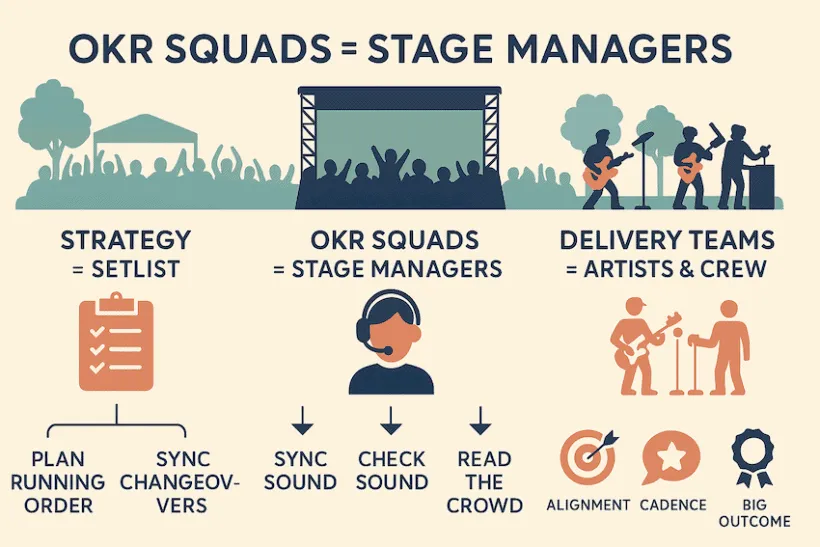
To understand the role of OKR Squads better, imagine your company as a music festival. The strategy is like the festival’s setlist, guiding the overall experience. Each OKR Squad acts as the stage manager for one part of the show. Delivery teams are the artists and crew who perform the songs. The squad doesn’t perform itself but plans the running order, synchronizes changeovers, checks the sound, reads the crowd, and ensures every set lands perfectly.
In business terms, this means creating alignment, maintaining cadence, gathering feedback, and making constant small course corrections that protect the big outcome. It is also essential for squads to deliver specified objectives and results as part of their responsibilities. This analogy highlights how squads keep the entire organization focused on the “north star” goals while adapting to real-time challenges.

Why Mid-sized and Large Organisations Benefit Most From Squads
Mid-sized to Large companies often face unique challenges. Every missed hand-off or unclear decision costs time and money. Setting goals with clear objectives and key results increases motivation and engagement among teams, helping everyone stay focused and inspired. OKR Squads help mid-sized to large firms overcome these hurdles by:
- Removing silos through cross-functional objectives and shared measurable sub key results.
- Increasing collaboration by providing teams with a common scoreboard and a single platform to resolve dependencies.
- Improving alignment by linking sub-KRs directly to strategic outcomes that leadership prioritizes, fostering motivation through setting and achieving shared goals.
- Speeding up execution with a lightweight operating rhythm of planning, check-ins, and retrospectives that fit seamlessly around existing meetings.
This approach encourages employee engagement and enhanced communication across departments, ensuring that everyone is pulling in the same direction.
Aligning OKRs: Getting Everyone on the Same Sheet of Music
Alignment is the secret ingredient that makes OKRs truly powerful. When aligning OKRs, organizations ensure that every team, department, and employee is working towards the same strategic outcomes, much like musicians in an orchestra following the same score. This process starts with company-wide objectives and key results, which then cascade down to teams, creating a clear connection between daily tasks and the organization’s overarching mission and vision.
Effective OKR alignment requires more than just setting goals; it demands ongoing OKR training, open communication, and strong support systems. Teams need to understand not only what they’re aiming for, but also how their measurable key results contribute to the company’s success. By tracking progress regularly and focusing on measurable outcomes, organizations can quickly identify what’s working, where support is needed, and how to adjust course for maximum impact. This focused approach helps employees stay engaged, motivated, and confident that their efforts are making a real difference. With the right guidance and a well-structured OKR process, aligning OKRs becomes a powerful way to create unity, drive progress, and achieve ambitious goals across the entire organization.
What the Rhythm Looks Like – OKR Cycles
The OKR cycle within squads follows a structured but flexible cadence designed to keep the organization agile and focused:
- Quarterly: Squads set an ambitious yet focused set of sub key results. They agree on which initiatives and activities from various departments will move these numbers.
- Fortnightly: Brief check-ins update measures, confidence levels, blockers, and next steps. These meetings are decision-oriented, avoiding unnecessary theater and admin. They communicate any impacts to the relevant initiatives and departments.
- Monthly: Teams review learnings, stop activities that no longer add value, and double down on efforts that drive measurable results. These monthly reviews play a crucial role in ongoing development and continuous improvement, supporting both professional growth and organizational progress.
- Quarterly Retrospective: The squad reflects on what worked, what didn’t, and what to try next to continuously improve the OKR process, further contributing to the development of agile and strategic initiatives.
Importantly, this rhythm is not extra bureaucracy. Instead, it offers a lighter, clearer way of running your business focused on outcomes rather than just activity.
Proof in Practice: Numatic International
This case study is one of several examples of successful OKR implementation with the Squad approach, specifically highlighting our work with Numatic International Ltd, a mid-sized UK company. By partnering with their leadership and cross-functional teams, we created OKR Squads and processes tailored for Numatic International that meet every two weeks to plan and review progress. This approach enhanced cross-functional collaboration and accelerated delivery against their strategic priorities.
The results were clear: faster dependency resolution, improved alignment, and a culture of transparency and accountability. You can explore this case study in more detail at McKenna Agile Consultants’ website: OKR Consultancy & Implementation for Numatic International Ltd.
Roles That Make It Work
Successful OKR implementations depend on defined roles that support the framework. Providing excellent service and support to teams and departments is essential to help them maximize your investment in the OKR process and adapt to changing needs:
- Executive Sponsors set the strategic direction and remove systemic blockers that could hinder progress.
- Squad Drivers co-define sub key results with their squad, align initiatives and daily work to those outcomes, run the cadence of meetings, keep reporting current, and escalate risks quickly.
- Teams and Departments own specific initiatives that move the sub-KRs forward. Their progress is transparent, trade-offs are visible, and support arrives early when needed.
This clear division of responsibilities ensures everyone knows their part in the OKR process, fostering accountability and engagement.
What You Can Expect in 90 to 180 Days
When you implement OKR Squads with the guidance of experienced OKR consultants, you can expect tangible results within three to six months:
- High-value strategic themes actively managed by OKR Squads.
- Clear sub key results that connect company strategy to delivery across multiple functions, leading to improved operations and streamlined processes.
- A new habit of regular check-ins that replace traditional status meetings with decision-focused conversations.
- Faster resolution of dependencies and fewer priority clashes.
- Visible momentum that energizes teams and reassures leaders.
This progress builds a strong foundation for continuous improvement and sustainable success.
Common Pitfalls to Avoid
While implementing OKRs can be transformative, it’s important to avoid common mistakes:
- Tool before system: Many organizations buy OKR software before designing their operating rhythm. Remember, tools support OKRs but don’t run them. Start with the process and cadence first.
- Too many goals: Focus is key. Setting a small set of ambitious objectives with sharp, measurable key results always outperforms a sprawling list of goals.
- Activity over outcomes: Track measures that prove real impact, not just effort or activity. Measurable goals help teams stay action-oriented and time-bound.
Avoiding these pitfalls will help you implement OKRs successfully and achieve meaningful business benefits.
Ready to Headline, Not Just Participate
If you are seeking to remove silos, improve collaboration, and accelerate execution, our OKR Consultants are ready to support you. We specialize in designing and embedding OKR Squads that make your strategy real and actionable. Typically, we guide clients through a 12-month journey with visible wins from the very first quarter.
Book a free consultation with our OKR experts and OKR coaches to design a squad approach tailored to your company’s strategy, context, and unique challenges. Our service includes guidance on OKR setting and learning OKR cycles to ensure continuous improvement and adaptability. We also provide access to practical OKR examples and resources to help you implement effective OKRs across your organization. Together, we’ll help your entire organization focus on ambitious goals, track progress with measurable key results, and create alignment that drives success.
By leveraging OKR methodology and the OKR framework through dedicated squads, your company can unlock the full potential of objectives and key results. With expert guidance, OKR training, and a clear process, your teams will be empowered to set challenging, audacious goals and achieve measurable results that propel your business forward.