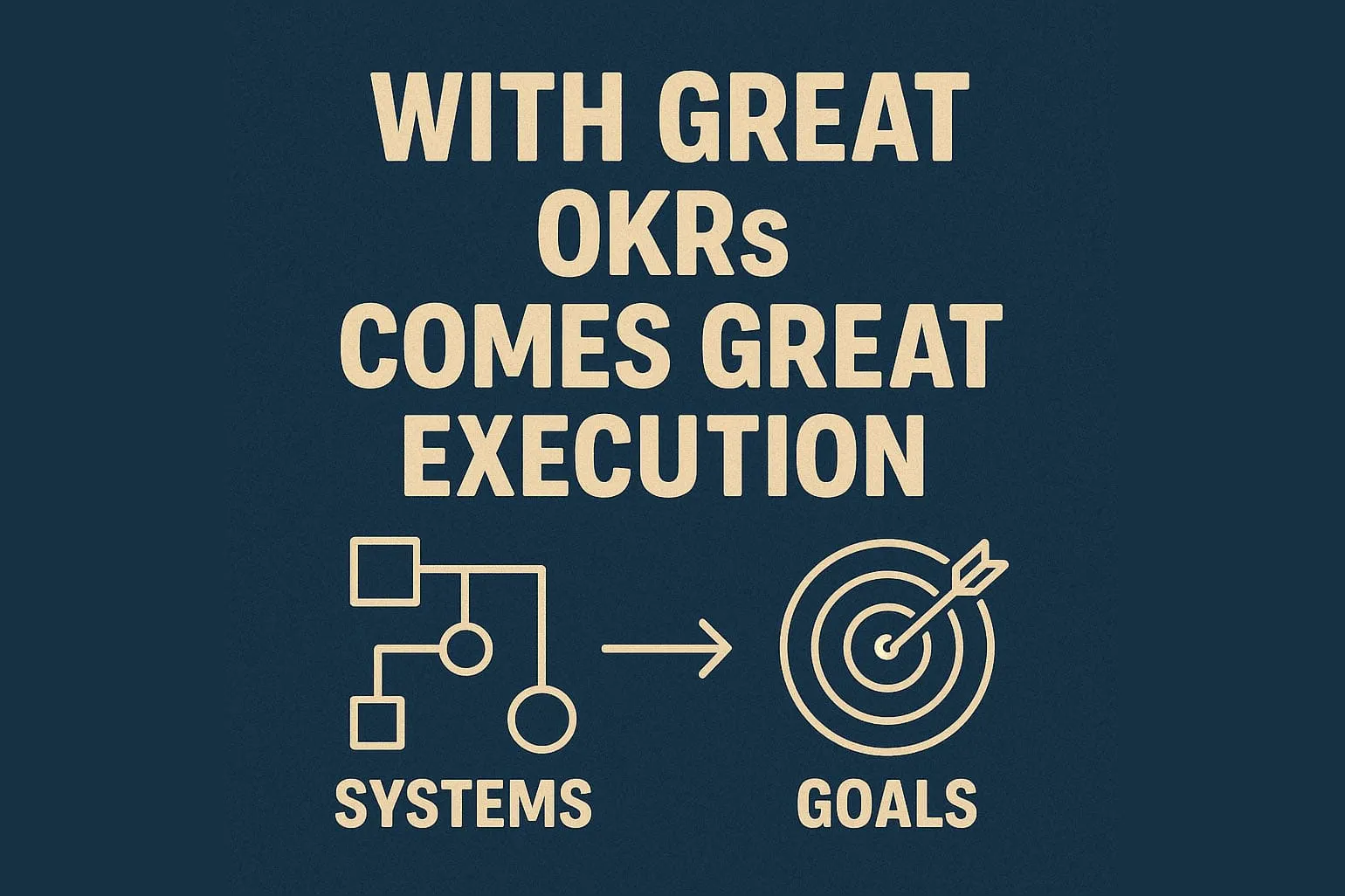
James Clear once wrote, “You do not rise to the level of your goals. You fall to the level of your systems.” It’s a reminder that ambition isn’t the problem for most organisations — execution is. Across industries, from manufacturing to financial services to tech, the companies that win aren’t always the ones with the boldest vision, but the ones that have built the systems to deliver it. According to the Global State of Strategy Execution (2025), only 11% of organisations reach world-class execution maturity. The difference isn’t strategy — it’s systems. Leaders who embed OKRs into consistent rhythms of planning, review, and learning outperform their peers by up to 30 points across all dimensions of strategy execution.
Voltaire — later echoed and popularised by Spiderman’s Uncle Ben — is credited with the proverb, “with great power comes great responsibility.” The same principle applies to OKRs. Ambitious goals are powerful, but without disciplined systems, they never translate into great execution.
At McKenna Agile Consultants, we’ve seen this first-hand across every sector we work in — from manufacturing and financial services to technology and the public sector. Ambitious strategies and bold OKRs are inspiring, but without robust systems, they struggle to take root. The truth is that you don’t need bigger goals; you need better systems to deliver them. Business agility is developed over time through continuous learning and deliberate evolution, rather than being a static framework.
Our approach is built on the combination of Agile and OKR methodologies, ensuring that both mindset and measurable outcomes work together for lasting success. This blog post explores the importance of creating and maintaining a finely tuned execution engine to support your strategic goals in 2026 and beyond.
From Goals to Systems Thinking for Strategy Execution
Our work is grounded in helping organisations move from goal setting to system design. We bring together Agile ways of working, OKRs, and practical change management to create structures that turn strategy into daily action. Agile gives rhythm and transparency. OKRs provide focus and direction. Together, they create alignment, accountability, and adaptability across teams. Each client receives a tailored system designed to meet their unique needs, ensuring measurable improvements in agility and strategic outcomes.
This approach has helped our clients replace static annual plans with living systems of execution — quarterly OKRs and planning increments, weekly check-ins, and real-time feedback loops that drive learning and progress. In addition to improving execution, we focus on developing leadership and professional skills. Leaders stop managing outputs and start managing outcomes. Decisions flow faster, priorities are clearer, and strategy execution becomes a daily habit, not an annual event, driving alignment across teams and strategic goals.
Recently, we’ve also shared these lessons with the next generation of OKR professionals through the OKRmentors Professional Coach (OKRPC) Programme, where we lead the module on the OKR Cycle and Rituals. The goal of this work is simple: to help leaders and coaches, including the leadership team, embed OKRs as a discipline, not a document. Our deep knowledge of agile methodologies and OKR practices ensures that organisations receive expert support in their transformation journey.
The Next Evolution: Intelligent Systems Powered by AI for Business Agility
The next frontier in strategy execution is already here. Artificial Intelligence is no longer a buzzword; it’s a genuine enabler of smarter systems. AI can enhance operations by improving delivery and responsiveness, integrating support and change management to help organizations respond effectively to opportunities and threats.
Used well, AI can transform how leaders operate. It can track progress, analyse patterns across check-ins, predict delivery risks, and surface insights before problems become visible. It can even summarise trends from qualitative feedback, allowing teams to act faster and with more confidence. AI also helps maintain and improve quality in outcomes and decision-making, while optimizing the allocation of resources for better results.
At McKenna Agile Consultants, we’re blending AI capability into Agile and OKR systems to help leaders make better decisions in real time. We provide solutions that integrate AI, Agile, and OKRs for clients, ensuring practical and effective support for agile transformations. The aim isn’t to replace human judgment but to enhance it. OKRs serve as a tool for strategic planning and execution. AI makes your system more intelligent; the system makes your strategy executable.
Five Ways to Stop Your OKRs Failing Because of Weak Systems
A focused approach to OKR execution is essential for driving meaningful results and organizational alignment.
- Create a steady cadence
Consistency beats intensity. Build a repeatable rhythm of OKR check-ins, reviews, and retrospectives. Integrate them into existing team meetings so that OKRs stay visible and actionable every week, not just every quarter. This helps in maintaining momentum and consistency in your OKR system. - Empower your OKR Champions
Champions act as the connectors between teams and strategy. They facilitate, coach, and keep OKRs front of mind. Invest in their development and give them space to shape how OKRs come to life. Support their OKR practices with coaching, training, and regular health checks to ensure best practices are followed. - Align OKRs with your portfolio of work
Link OKRs to strategic initiatives. When every project or sprint maps to a measurable outcome, you get alignment from top to bottom — and visibility of which investments really move the needle. Ensure each OKR is focused on a clear objective to drive measurable progress. - Measure confidence, not just results
Use confidence scoring to identify risk early and encourage honest reflection. This gives leaders a leading indicator of progress rather than waiting for the numbers to reveal problems too late. - Blend AI into your feedback loops
Use AI tools to automate reporting, extract insights, and predict trends. Let the data work for you so your people can focus on making better decisions and learning faster.
Make 2026 the Year You Fix Your Systems
If you want your strategy to deliver in 2026, start by strengthening your systems now. The gap between ambition and achievement is always execution, and the organisations that thrive are those that treat systems as a strategic advantage.
At McKenna Agile Consultants, we help leaders build the rhythms, roles, and routines that connect strategy, OKRs, and Agile practices into one clear system of execution. If your organisation is ready to move beyond goal-setting and start delivering measurable impact, now’s the time to act.
Get in touch today to discover how we can help you design the systems that make success inevitable.