We are frequently asked by leaders how to actually start an agile transformation. Not the theory. Not reciting the agile manifesto. The practical, “what do we do on Monday morning?” kind of start.
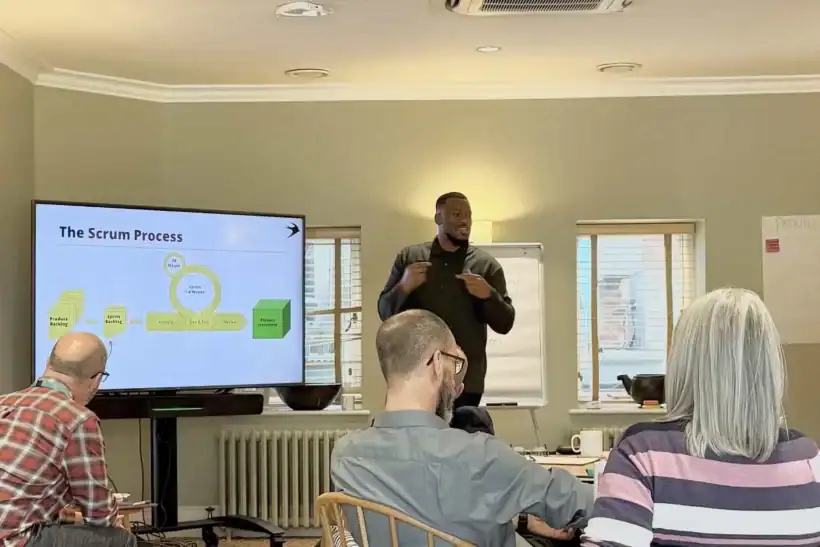
That question is exactly why we built the Agile Implementation Template, a single-page, 9-box framework that helps teams and leaders think through the critical dimensions of going agile. We used it most recently in January this year, when Simeon and I ran an Agile Implementation Workshop for a new client. And it worked brilliantly.
In this post, I will walk you through each box, explain what it is for, share an example, and connect it to a piece of theory or analogy that brings it to life. You can download the full template for free at the bottom of this article.
Box 1: Outcomes and Evidence of Agility
Why change, and why now? Before anything else, you need to articulate the burning platform. Why is the current way of working no longer fit for purpose, and why does this matter right now? Without a compelling “why,” change fizzles out the moment things get uncomfortable. In one of our client Agile Implementation workshops, the leadership team identified that time-to-market had nearly doubled in 18 months. Competitors were shipping faster, and customer satisfaction was slipping. That was their “why now.” This maps directly to John Kotter’s first step of change management: Establish a Sense of Urgency. Kotter’s research found that transformation efforts fail most often when leaders skip this step. No urgency, no momentum. Once you know why change is needed, you need a picture of what “good” looks like. This box captures your future-state vision and the operating model that supports it. Your North Star. We translated this into the outcomes that they wanted to measure and evidence of agility they wanted to demonstrate. We like to create OKRs with our clients to define this.
Box 2: Transformation Scope
What is the vision for the transformation and what does it encompass? Our client envisioned cross-functional teams owning products end-to-end, weekly releases rather than quarterly, and teams empowered to make decisions without escalating everything upward. Think of it like a road trip. Box 1 told you why you need to leave. Box 2 is choosing your destination. Without it, you are just driving in circles with good intentions and burning fuel fast.
Box 3: Roles, Leadership and Enablement Network
People are the engine of any agile transformation. This box forces you to think about how the change is led, how teams will be organised, how teams will be supported, what roles are needed, and how they will be structured. Get this wrong and you create confusion, duplication and frustration. The client we worked with in January moved from functional silos to cross-functional teams aligned to customer journeys. Each squad included a Product Owner, Scrum Master, developers, testers and a UX designer. Amy Edmondson’s research at Harvard Business School shows that psychologically safe, stable teams consistently outperform groups of talented individuals who are constantly reshuffled. Stability is the foundation of genuine agility.
Box 4: Cadence and Planning Rhythm
This is where you define the rhythms and rituals of your agile teams. What ceremonies will you use? How will work flow from idea to delivery? This is the operational heartbeat. We helped the client design a two-week sprint cadence with daily standups, sprint planning, reviews and retrospectives, plus a bi-weekly cross-team sync. If your teams are a band, your ceremonies are the rehearsal schedule. The best musicians in the world still sound terrible if they never practise together. Ceremonies create the rhythm that turns individuals into a team.

Box 5: Core Agile Rituals and Integration
This box helps to think about how agile rituals sync seamlessly with existing meetings, structure and governance. Use this to challenge assumptions about how you currently work. One of the biggest friction points in agile transformation is ambiguity around who decides what. This box can help to map out decision-making authority so teams are genuinely empowered while leaders maintain oversight. We used a simple framework with our client: team-level decisions (sprint priorities, technical approach) were fully delegated. Product direction needed Product Owner and stakeholder alignment. Budget decisions stayed with senior leadership. David Marquet’s “Intent-Based Leadership” from Turn the Ship Around! is the perfect reference here. He transformed the worst-performing submarine in the US Navy into the best by pushing decisions down to the people closest to the information. The lesson: give control, don’t take it.
Box 6: Work Visibility, Flow and Data
You cannot improve what you cannot see. This box is about making work visible, measuring flow, and using data to drive better decisions. It is the antidote to “gut feel” management. The client set up digital Kanban boards for each squad, introduced cycle time tracking, and agreed on a small set of flow metrics including throughput, work-in-progress limits and lead time. Don Reinertsen’s The Principles of Product Development Flow shows that most organisations dramatically underestimate the cost of invisible work-in-progress. Making work visible and managing flow can improve delivery by 30-50% without adding a single extra person.
Box 7: Learning, Capability and Onboarding
Agile transformation is a learning journey, not a one-off installation. This box addresses how you will build the skills and confidence your people need to thrive. We designed a blended plan for our client: formal Scrum training, coaching for Product Owners, leadership workshops, and a buddy system for onboarding new team members. Imagine buying everyone new golf clubs but never offering a lesson. You would not expect anyone to play better. Giving teams new processes without investing in capability is a recipe for expensive frustration.
Box 8: Change Risks, Resistance and Systemic Blockers
Every transformation has headwinds. This box is your honest assessment of the risks, the likely sources of resistance, and the systemic blockers that could derail your agile journey if left unaddressed. Our client identified three key risks: middle management uncertainty about their changing role, a legacy approval process that conflicted with team autonomy, and a vendor contract that mandated waterfall milestones. The Harvard Business Review reports that 70% of change initiatives fail, most commonly due to people-related resistance, not poor strategy. William Bridges’ “Transition Model” reminds us that change is situational (a new org chart) but transition is psychological. People need time to let go of the old before embracing the new.
Box 9: 90-Day Transformation Focus
Grand visions are inspiring, but they can also be paralysing. This final box brings everything together into a focused, actionable 90-day plan. What are you going to do first? What does success look like in three months? The client’s 90-day focus included: launch two pilot squads, deliver first sprint reviews to stakeholders, complete Scrum training for all squad members, and establish initial flow metrics dashboards. This is your “minimum viable transformation.” Just as agile teams ship an MVP to learn fast and iterate, your 90-day plan is about getting results quickly and building momentum. You are not transforming the entire organisation in 90 days. You are proving that the direction is right.
Ready to Plan Your Agile Transformation?
If you are a leader in the UK planning an agile transformation, or an agile consultant looking for a practical workshop tool, we would love for you to try our template.
Download the Free Agile Implementation Template
If you would like to talk about how we can help you run an Agile Implementation Workshop for your teams, get in touch.
Aaron McKenna is the founder of McKenna Agile Consultants, a UK-based agile consultancy specialising in agile transformation, coaching and training. Aaron and the team work with organisations across the UK to help leaders and teams become genuinely agile in practice.