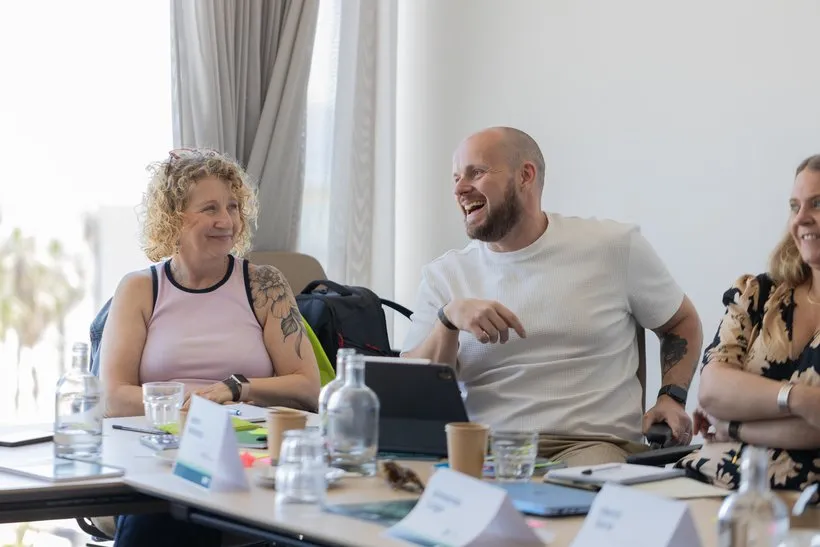
In late May, we returned to Barcelona for the third year running of the OKR Mentors Annual Gathering. Two days, one room, and a group of strategy execution practitioners from across the world that has become — for us at McKenna Agile Consultants — one of the most useful professional rooms we step into all year.
Looking back over the journey is interesting. In 2024, the gathering was about building community: meeting the people behind the books, the courses and the consultancies, and starting to compare notes on what genuinely worked in OKR implementations. In 2025, it shifted gear — from sharing ideas to contributing to shared infrastructure. AI moved from buzzword to working tool. OKR Champions emerged as the quiet difference-makers. The collective started behaving less like a network and more like a community of practice.
In 2026, the conversation has matured again. This year felt less like “what tools should we use?” and more like “what is the discipline behind making strategy execution actually work?” The bar for the conversation has risen — and so have the stakes for the organisations we serve.
If there was a single, dominant theme running through both days, it was this: Strategy Execution. Not as a slogan or a slide title, but as a body of work in its own right — a discipline with its own language, its own roles, its own tools and its own emerging tradecraft. OKRs were everywhere in the conversation, of course, but the frame around them has shifted. OKRs are increasingly understood as one instrument inside a much wider strategy execution practice, not a stand-alone initiative.
Here are the takeaways we’re bringing back into our work.
Are OKRs the new agile?
It’s a question we kept circling around at the gathering, and one we think deserves an honest answer.
Anyone who lived through the last twenty years of agile transformation will recognise the pattern. A simple idea gets adopted at scale. The early adopters report extraordinary results. Then the bandwagon arrives — frameworks, certifications, posters in meeting rooms, and eventually a backlash. “Agile is dead.” “Agile doesn’t work.” Conferences full of cautionary tales.
We’re starting to see the same energy turned on OKRs. And some of it is fair — there are plenty of OKR rollouts that have failed in exactly the way agile rollouts failed: surface-level adoption, no real change in behaviour, leadership signing off on a deck and assuming the work is done.
But the answer isn’t to ask “do OKRs work or not?” That’s a binary, and it’s the wrong question.
The right question is “how do you do this well?” OKRs are a discipline, not a switch. Like agile before them, the value is unlocked not by adopting the artefacts, but by building the practice — the rhythms, the conversations, the culture and the capability — around them.
We’re going to keep reframing the narrative when we hear it. The conversation isn’t “yes or no.” It’s “how.”
Strategy Execution or Strategic Execution?
One of the more curious threads at the gathering was a definitional one — and in a room of practitioners, it really mattered. Are we executing strategy, or executing strategically? The words look almost interchangeable, but they describe genuinely different problems, and the fact that the discipline does not yet have a shared answer tells you something about how young it still is.
Strategy Execution is about turning a chosen direction into reality. It assumes the strategy is set, and the work is to translate it into objectives, behaviours, decisions and outcomes that move the organisation in that direction. It is a discipline of delivery — cadences, governance, capability, OKRs, the works.
Strategic Execution is the inverse. It is about how you execute being strategic in itself — the trade-offs, the reprioritisation, the sense-making in flight. It assumes the world will shift faster than the strategy can be re-written, and that the way the organisation responds is, in itself, where competitive advantage is built.
You need both. In our experience, organisations that conflate the two end up either rigidly executing a strategy that no longer fits, or perpetually reacting in the name of agility without any underlying direction at all. Strategy Execution is the discipline. Strategic Execution is the muscle. Naming them separately is the first step to building both.
Strategy cycles are compressing — and transformation is now BAU
In his opening keynote, Elie Casamitjana, Founder and CEO of OKR Mentors, walked us through the OKR Mentors Market Signals 2026 report — a sharp read of what the data is currently telling us about strategy execution. Every number in this section is drawn from that report. A few figures stuck with us:
- Transformation budgets aren’t shrinking — they’re being redirected. The money is still being spent on change, but the destination has shifted. And only around 2% of those transformation budgets are being spent on capability building, which goes some way to explaining why so many programmes feel like they fade after the launch.
- Global interest in OKRs continues to climb. Search trends are up across most major markets — with the notable exception of the US, where the curve has plateaued. The discipline is going global, but maturity is uneven.
Underneath those data points sits a bigger shift. Strategy cycles are getting shorter. Two further numbers from the same Market Signals 2026 report make this concrete: 47% of CEO time is now spent on horizons under a year (PwC CEO Survey 2026 — based on 4,454 CEOs), and only 30% of CEOs feel confident about revenue growth over the next 12 months (same source). Caution shortens horizons; shortened horizons compress strategy cycles. What used to be an annual planning exercise with a tidy three-year horizon is now a rolling, quarterly conversation under near-constant pressure to re-plan. And the work of executing the strategy — once treated as a discrete “transformation programme” with a start and end date — has become continuous. Transformation is now business as usual.
That’s a profound shift, and the Market Signals 2026 data shows it landing hard at the top. 35% of executives now name the planning–execution disconnect as the #1 barrier to reinvention (PMI 2025 Step Up Report — based on 5,800 project professionals), and 70% of chief strategists have little confidence they can close the execution gap (HBR / GWork). So the question many leadership teams are still working out is the obvious one:
Who, at C-level, actually owns strategy execution?
The CEO owns the strategy. The CFO owns the numbers. The COO owns operations. But the bridge between intent and impact — the discipline of turning strategy into the right outcomes, quickly, repeatedly, across functions — is often nobody’s clear remit.
This was one of the most candid conversations of the gathering. There is a gap at the top of many organisations, and that gap shows up everywhere downstream: misaligned priorities, duplicated work, programmes that never quite ladder back to strategy, and the perennial tension of asking the same people to perform in the current operating model and transform into the next one — usually with the same calendar and the same headcount.
This is, increasingly, the work we do at McKenna Agile Consultants: stepping into that governance gap. Helping leadership teams design the cadence, the structures and the capability so that strategy execution becomes a deliberate, observable practice — not an emergent property of who shouted loudest in the quarterly review. The partners we see carrying this load today, often without the system around them to make it sustainable, are the Directors of Strategy & Operations, the heads of PMO, and the Transformation leads.
Capabilities or system? Both. It’s a dual operating system.
A recurring question across the two days was whether OKR and strategy execution work is fundamentally about building capability in people, or about installing a system — cadences, tools, governance, data — for the organisation.
The honest answer is: it’s both, and treating them as a choice is part of why so many programmes stall.
You can build a beautiful capability layer — trained champions, coached leaders, brilliant internal facilitators — but if there is no system to run on, the discipline atrophies the moment those people get pulled onto something else. Equally, you can install a slick system — tooling, dashboards, quarterly rhythms — but without the capability to use it well, you end up with a beautifully instrumented theatre of activity that doesn’t change a single decision.
The framing we found most useful was the dual operating system: capability and system, running in parallel, deliberately designed to reinforce each other. The capability layer makes the system feel human. The system makes the capability stick.
AI: from “partnership, not proxy” to a change in rhythm
In 2025 we wrote about AI being a partner to strategy execution, not a proxy for strategic thinking. That framing still holds — but in 2026 the conversation has moved on from whether AI belongs in the workflow to where it earns its place.
The most useful framing we heard at the gathering: AI is changing the rhythm of strategy execution.
Strategy cycles compressing, transformation as BAU, governance still catching up — without help, the human bandwidth simply isn’t there. AI, used well, gives that bandwidth back. We saw practical, grounded examples across the two days:
- A leading strategy execution tool provider walked us through a case where, inside a single organisation, more than 300 teams were independently working on the same outcome — and nobody knew. AI surfaced the duplication, leadership reallocated the effort, and the duplicated work disappeared. That isn’t an OKR problem. It’s a visibility problem, and AI is increasingly the way to solve it at scale.
- Consultants and platforms across the room showed how AI-assisted drafting now condenses the front end of OKR-setting from days to hours, freeing teams to spend the time on the strategic conversation rather than the wordsmithing.
We were also honoured to be asked to present our own work in this area to the collective. At McKenna Agile Consultants, we have been investing heavily in Agentic AI — autonomous AI agents purpose-built to take the reporting burden off strategy execution teams. The agents surface blockers in real time, track OKR progress automatically against the underlying systems of work, and reserve the human conversation for the moments that genuinely need a human. Too many teams today spend more time reporting on their OKRs than acting on them; Agentic AI is, in our view, the most credible way to close that gap at scale.
Sharing the work with a room full of practitioners who immediately understood why it mattered was energising — and the conversations afterwards have already shaped our roadmap. Several members of the collective are already exploring how Agentic AI fits into their own engagements, and we expect this to be one of the most active areas of shared development across the community over the next twelve months.
The principle that grounded the 2025 conversation still grounds 2026: AI doesn’t replace strategic thinking. But where it can compress the admin around strategic thinking — and embed itself in the rhythm of execution — it has earned its seat at the table.
A new tool we’re working on: the Strategy Execution Canvas

One of the actions we’re taking out of Barcelona is a new tool we’ve been shaping for leadership teams: the Strategy Execution Canvas.
It’s designed as a one-to-two-day workshop format that helps leadership teams make their strategy execution system visible. Where are the cadences? Where is the governance? Where do strategy, capability, OKRs, capacity and data actually connect — and where, more often, are they not connecting? The canvas turns the implicit into the explicit, and gives the leadership team a tangible thing to argue about, refine, and own.
Particular thanks here to Nathalie Arrizabalaga for her thought partnership during a working session on this. The best ideas at gatherings like this one almost always come from working sessions of two or three experts pulling at the same thread — and this is exactly that.
We’ll be sharing more about the Strategy Execution Canvas in the coming weeks. If you’d like an early look, get in touch.
Three years in: from network, to community of practice, to strategy execution discipline


Looking back across the trilogy of gatherings, the arc is clear.
In 2024, we left Barcelona with a network — names, faces, and a shared sense that the work mattered. In 2025, that network started to behave like a community of practice — sharing tools, prompts, frameworks, and the trust to build on each other’s ideas rather than compete with them. In 2026, we left with something more: the beginnings of a strategy execution discipline. A shared language, a shared understanding of where it sits in the organisation, and a shared commitment to keep building the practice in the open.
That’s not a small thing. Strategy execution doesn’t need another framework. It needs a discipline — and it needs the practitioners, the leaders, the systems and the Agentic AI agents working together to make it stick.
An honest retrospective on the off-agenda OKRs
In the interest of full transparency, our own personal OKRs for the week did not all hit green. Objective: be in bed by a reasonable hour. Key Result: missed by approximately three hours per night, every night. Objective: pace ourselves on the tapas. Key Result: not measurable, because nobody was counting and we have politely agreed never to find out. Objective: leave the dance floor before the lights came on. Key Result: stretch target — we’ll try again in 2027.
Joking aside, the long lunches, the late dinners, the walks along the marina, the paella, the sangria, and yes, the dancing, are part of why this community works. Trust gets built between the sessions, not just in them. And when you come back to a difficult client conversation knowing the experts on the other end of the email actually have your back — that’s worth more than any framework.
We’re already looking forward to 2027.
Ready to evolve your strategy execution practice?
If anything in this post resonated — whether you’re wrestling with the governance gap, building a community of OKR Champions, integrating Agentic AI into your strategy rhythm, or simply trying to make your strategy more connectable to the teams doing the work — we’d love to talk.
A great place to start is our free Strategy Execution Assessment. It takes about ten minutes, gives you an immediate read on where you stand, and is the conversation starter we use with our own clients.
Strategy execution isn’t a product. It’s a practice. The best practices are built in community — and we’d be glad to build one with you.