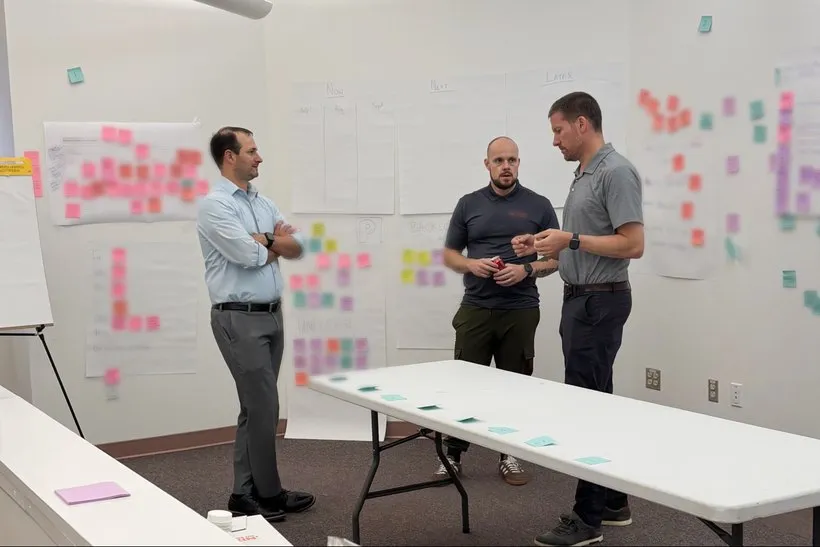
Earlier this month we spent three days on site in Philadelphia with a client — a manufacturer of smart lighting and shading control systems for homes and commercial buildings. They’re engineers at heart — decades of respected hardware and a loyal dealer network — now doing more and more in software. And software moves at a different speed: the ways of working that made the hardware great were starting to slow the software down.
They didn’t ask us for a framework. They asked us for a way to start. And that distinction shaped everything about how we designed the week — because every agile transformation needs a starting point, and the best starting point is almost never “roll it out everywhere”. It’s one portfolio, one group of leaders, one working system you can point at.
In other words: strategy execution, not strategy theatre. Here’s what we did, what worked, and what you can steal.
The shape of the three days
We didn’t walk in cold. In the weeks before the workshop we ran a round of one-to-one interviews with the leaders who’d be in the room, and the same problems came up again and again — chief among them a feeling that the organisation had drifted too far from its customers, and an intake process so heavy that ideas were exhausted before they were ever tested. And we opened Monday morning the way we always open a big engagement: by setting an OKR for the workshop itself — a habit we explained in OKRs and ADKAR: Change Management That Sticks, because it models the behaviour we’re asking the room to adopt.
The three days were built to answer those problems in order:
- Day one — see the business as a portfolio. We taught the foundations — lean-agile principles, the product operating model, the shift from projects to products — and then two groups built Portfolio Canvases for their part of the business: value streams, solutions, customers, channels, revenue. By the end of the day each group had a draft portfolio mission, in their own words, on the wall.
- Day two — decide what good looks like. A full day on OKRs: the leadership team drafted a small set of enterprise objectives, wrote measurable key results against each, then tore into their own drafts in a retrospective. That instinct matters: teams that mark each other’s homework honestly write better OKRs than teams that declare the first draft finished.
- Day three — make it run. Roles, cadences, an ADKAR-based change plan, and a Now / Next / Later roadmap with a 30/60/90-day plan underneath it. The week ended with the group scoring the workshop OKR we’d set on Monday morning — did we actually deliver what we said we would?
The centrepiece that sat across days one and three: a physical portfolio Kanban, built by the room, with every initiative in flight or in the funnel written up as a card. Then we made them prioritise it properly — Weighted Shortest Job First, scored live, twenty initiatives debated over and ranked. Watching a leadership team discover that their pet initiative scores below something unglamorous but urgent is one of the quiet joys of this job.
The football break
A confession about day three. At 12 noon local time, we stopped the workshop.
Not for a fire alarm. For England vs DR Congo in the World Cup knockouts. We were in Philadelphia in the middle of a home World Cup — the tournament was on every screen in the city that month — and full disclosure: the only England fan in the building was me. The room was US supporters and casual World Cup watchers, but nobody needed much persuading. The match went up on the big screen, lunch was ordered in, and for a couple of hours the portfolio waited.

And it was time well spent. After two intense days, watching the match together was the first time the group relaxed as one team rather than debated as heads of separate functions. Transformations run on relationships as much as they run on plans — and relationships get built in the gaps between sessions as much as in the sessions themselves. So when you design a big workshop, design the gaps too.
(England won. As the only England fan in the room, I celebrated with dignity. Mostly.)
Three takeaways you can use
1. Pilot one portfolio, and give the momentum a named owner
The workshop OKR we set on Monday morning wasn’t “train everyone”. It was: pilot this way of working with one business group, on one portfolio, and prove an approach the organisation can scale. And the key result that mattered most was deliberately uncomfortable — within 30 days, the portfolio owner has the Kanban live and WIP-limited, with the top initiatives pulled into flight, run by the portfolio, not by the facilitators.
If your success measure is “the workshop happened”, the workshop is all you’ll get. Name the person who owns the system after the consultants leave, and put a date on it — in front of the room.
2. Let their own process make the case for change
The most persuasive slide of the week wasn’t ours. It was theirs: the intake document every new initiative had to survive — page after page of approvals and a long stakeholder sign-off list just to enter the backlog. We put it next to a one-page lean, problem focused business case and asked one question: how lean dare we go?
Nobody defends a document like that once it’s on the wall. But the point isn’t ridicule — that document was somebody’s rational answer to a governance problem, and the room needed to name what it protects before letting it go. Find your organisation’s equivalent artefact and give it an honest hearing in daylight. It will do more than any burning-platform speech.
3. Change lands one person at a time — so build the change plan in the room
We closed the engagement the way we always try to: not with a rollout plan, but with an ADKAR-based change plan the leaders built themselves — who is impacted, what has to happen at each stage from awareness through to reinforcement, and who the change champions are. That last output matters: champions are discovered, not appointed, and some of the best names on the list weren’t in the room.
A transformation that lives in a deck belongs to the consultants. One that lives in a canvas the leadership team filled in, argued over and merged into a single plan belongs to them. Guess which one survives contact with Q3.
What they left with
By Wednesday evening the walls held two portfolio canvases and a combined mission, a set of enterprise OKRs with key results the leadership team wrote themselves, a prioritised portfolio Kanban with twenty WSJF-scored initiatives, a role map, a change plan with named champions, and a Now / Next / Later roadmap with 30/60/90-day commitments. Every artefact photographed, transcribed and back in their hands as a working document within the week — because outputs that stay on flipcharts die on flipcharts.
The honest caveat, as ever: three days starts a transformation; it doesn’t finish one. The real test is happening right now, thirty days on, in whether that Kanban is still being pulled from when we’re not in the building.
If this is the year you start
We work with leadership teams whose strategy is set and whose challenge is execution — and the pattern in this post is repeatable: interview honestly, pilot one portfolio, build the system with the people who’ll run it, and plan the change as deliberately as the delivery.
If you’re staring at your own version of that intake document and wondering where to start, start with a conversation. Book a free consultation and we’ll talk through what a pilot could look like in your organisation — or take our free Strategy Execution Assessment for an honest ten-minute read on where you stand.
Just maybe check the World Cup schedule before you book the dates.